


“Practical Permaculture” is a column written by Santa Fe Permaculture’s founder and President, Nate Downey. It appears in “The Santa Fe New Mexican’s” monthly Real Estate Guide.
Fire Management
On the first full day that Los Alamos re-opened after the fire, the effects of the catastrophe were everywhere. Green ribbons were wrapped around telephone poles to thank firefighters. Red Cross vehicles waited in traffic. A big, hand-painted sign advertised “FREE SHOWERS”. Along Diamond Drive, cops were stopping rubbernecks like me from snooping around the burnt-out neighborhoods.
Not much smoke wafted through the “City on the Hill”, but a thick haze choked Española. The huge cloud finally dissipated on the other side of Oklahoma according to a interview on the AM dial. Everyone was trying to make sense of the city’s newly blackened backdrop.
There’s been a firestorm of finger pointing. Blaming the poor soul who struck that fateful match is silly when one considers that an even worse fire (starting below, instead of next to, the city) could easily be ignited by a careless smoker, a car backfiring, or a bolt of lightning. On the other hand blaming an “Act of God” after decades of suppressing natural fire cycles also seems ridiculous.
The ultimate cause of the catastrophe is that, most modern people do not put enough thought into their land before they develop it. We tend to think about a piece of property just as it was on the first day we laid eyes on it. We are oblivious to nature’s power — just as nature is oblivious to whomever thinks he has the power to own her.
In order to combat this problem permaculture design stresses two important strategies. The first is ‘site selection’. There are appropriate and inappropriate places to build. The tops of big hills in fire-dependent landscapes are among the least appropriate. In the heat of battle, it was appropriate to protect a secret lab high above some steep, densely forested terrain. On a day like today, however, it does not take a rocket scientist to see that the site for the Manhattan Project is much less appropriate as a site for a large human settlement.
‘Design for catastrophe’ is the other strategy. In the case of fire, if an inappropriate site has already been selected, we design ways to prevent the fire from having a catastrophic effect. First, we determine the fire’s likely path. Slope is often the determining factor, but wind directions, fuel loads and moisture content within fuel loads all play critical roles in determining a fire sector.
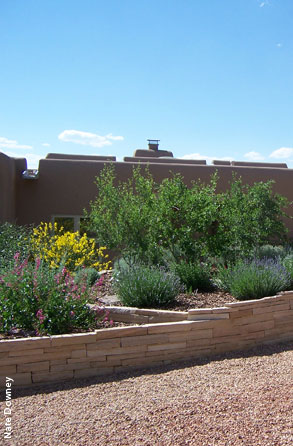
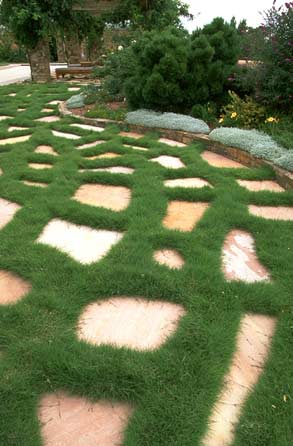
Once the fire sector has been determined, we then decide how to incorporate a variety of techniques. Firebreaks, driveways, ponds, animal grazing pastures, on-contour swales, fire retardant species, graveled areas, hardscaped patios, high water-use flora (such as vegetables and fruit trees) can all be placed in the fire sector.
Sprinkler systems can also be installed on rooftops, but remember that fire can take out power lines rendering pumps useless — just as pumps died at important water tanks during the Cerro Grande. This means that an alternative power source such as solar panels should be designed and installed to create redundancy.
As part of the design, residents need to be educated about wildfire. It is essential to understand that people do not usually burn up in flames during a crown fire; the radiant heat far out in front of the flames poses the real danger. Therefore a root cellar is an ideal place to be during a fire — much safer than in a car. Sometimes even waiting in the fire shadow of a house until the fire passes could mean life or death.
It should be obvious that designing for catastrophe is much more expensive and more risky than putting thought into the process of site selection. It should also be made clear that there are many natural catastrophes to consider including floods, landslides, earthquakes, tornadoes, hurricanes, etc. Fortunately, here in northern New Mexico we have relatively few natural catastrophes, and our most common catastrophe, fire, happens to be one against which a good design can have a significant effect.
Published: June, 2000 | Copyright © 2000, Nate Downey.